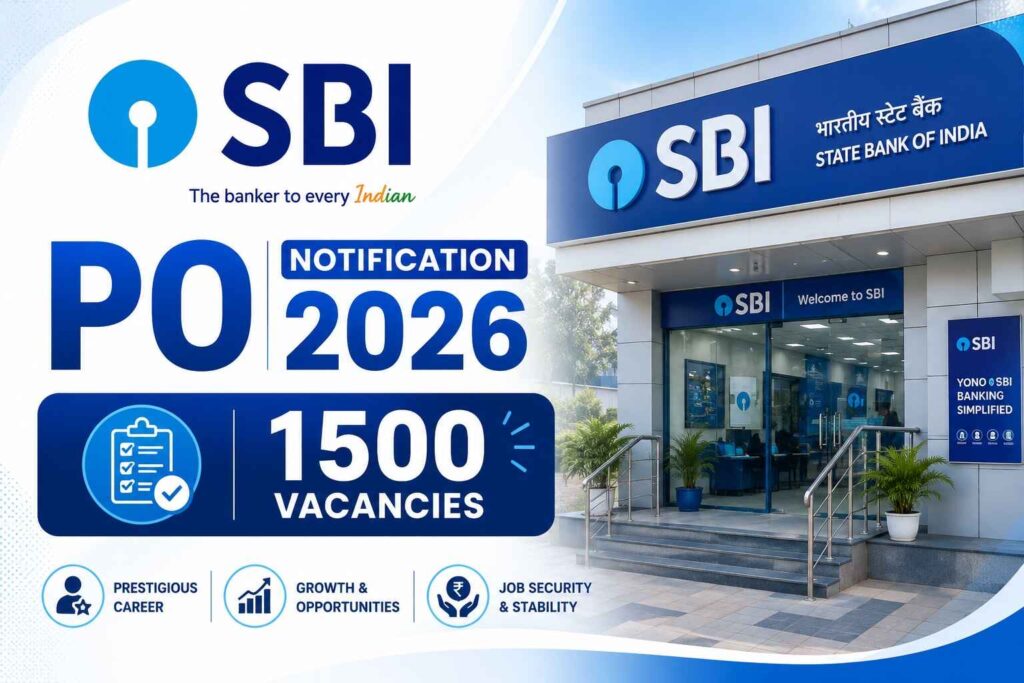
State Bank of India released the SBI PO Notification 2026 on 18 June 2026, opening 1500 Probationary Officer vacancies — nearly triple last year’s count of 541. The online applications are open now and will be closed on 8th July 2026. The Prelims Exam is expected in August and Mains in September.
For lakhs of banking aspirants, this is the recruitment cycle to watch. The vacancy jump alone changes the competition math significantly, and SBI has also revised attempt limits, salary, and exam marks distribution this year. If you’re preparing for SBI PO 2026 or deciding whether to apply, this article walks through every number and deadline that matters, plus what the changes actually mean for your chances.
Key Highlights
- 1500 vacancies announced — 1446 regular + 54 backlog (up from 541 in 2025)
- Online registration: From 18 June 2026 to 8 July 2026
- Prelims expected August 2026, Mains September 2026
- Age limit: 21–30 years as on 1 April 2026
- Application fee: ₹750 (Gen/EWS/OBC); Nil for SC/ST/PwBD
- Approximate CTC at Mumbai centre: ₹20.97 lakh, up from ₹20.43 lakh
- Attempt limits raised: UR/EWS now 6 attempts (up from 4), OBC 9 attempts (up from 7)
- Selection: Prelims → Mains → Psychometric Test, Group Exercise & Interview
- Aadhaar verification now mandatory; new exam centres added in Kurukshetra, Ayodhya, Churachandpur, Mysuru
Quick Answer
SBI PO Notification 2026 out for 1500 Probationary Officer Vacancies. You can apply online from June 18 to July 8, 2026, on the official SBI careers portal. Graduation degree in any discipline is required and your age should be between 21-30 as on 1 April 2026. Selection process consists of Prelims, Mains and Phase III which includes Psychometric Test and Group Exercise and Interview.
SBI PO 2026 Overview
Particulars |
Details |
|---|---|
Organisation |
State Bank of India |
Post |
Probationary Officer (Junior Management Grade Scale-I) |
Total vacancies |
1500 |
Registration window |
18 June – 8 July 2026 |
Age limit |
21–30 years (as on 01.04.2026) |
Qualification |
Graduation in any discipline |
Application fee |
₹750 (Gen/EWS/OBC); Nil (SC/ST/PwBD) |
Selection stages |
The selection process includes a Preliminary Test, Main Test, Psychometric Evaluation, Group Exercise, and Interview. |
Starting basic pay |
₹48,480 |
Approx. CTC (Mumbai) |
₹20.97 lakh |
Service bond |
₹2 lakh, 3-year minimum service |
Official site |
sbi.bank.in |
Key Takeaway: The fee waiver for SC/ST/PwBD candidates and the modest ₹750 fee for others keeps the entry barrier low relative to the salary on offer — but the real filter is the exam itself, not the form.
Important Dates for SBI PO 2026
Event |
Date |
|---|---|
Notification released |
18 June 2026 |
Online application |
18 June – 8 July 2026 |
Pre-Examination Training (SC/ST/OBC/PwBD) |
1 July 2026 |
Prelims admit card |
Mid/late July 2026 |
Prelims exam (Phase I) |
August 2026 |
Prelims result |
August/September 2026 |
Mains admit card |
August/September 2026 |
Mains exam (Phase II) |
September 2026 |
Mains result |
September/October 2026 |
Phase III call letter |
October/November 2026 |
Psychometric Test, GE & Interview |
October/November 2026 |
Final result |
November/December 2026 |
Action Step: Set a reminder for 8 July 2026 — don’t wait until the last 48 hours, since SBI’s application portal historically slows under peak load in the final two days.
SBI PO Vacancy Breakdown 2026
Category |
Regular |
Backlog |
Total |
|---|---|---|---|
SC |
216 |
18 |
234 |
ST |
108 |
36 |
144 |
OBC |
390 |
— |
390 |
EWS |
144 |
— |
144 |
UR |
588 |
— |
588 |
Total |
1446 |
54 |
1500 |
PwBD candidates are accommodated horizontally within these category numbers, as per SBI’s standard reservation framework.
What Changed in SBI PO 2026
This year’s notification carries more structural change than a typical annual update:
- Vacancies: 541 → 1500
- Salary: Mumbai CTC up from ₹20.43 lakh to ₹20.97 lakh (some sources cite ₹21.97 lakh; verify the exact figure in the official PDF, as media reports vary slightly)
- Mains descriptive marks: Cut from 50 to 30
- Total Mains marks: Reduced from 250 to 230
- Attempts: UR/EWS now get 6 attempts (was 4); OBC gets 9 (was 7); SC/ST remains unrestricted
- Aadhaar verification: Now mandatory at application stage
- DPDP Act compliance: A formal data-consent clause has been added, in line with the Digital Personal Data Protection Act, 2023
- PwBD eligibility: Candidates with temporary disabilities expected to improve are no longer eligible under PwBD
- CIBIL relaxation: Credit-default clearance deadline extended to the date of joining instead of an earlier cut-off
- New exam centres: Kurukshetra, Ayodhya, Churachandpur, and Mysuru added
Eligibility Criteria 2026
Educational Qualification
- Graduation in any discipline from a recognised university
- Final-year/final-semester students can apply provisionally, but must furnish proof of passing by the specified cut-off date
- Professional degrees — Medicine, Engineering, Chartered Accountancy, Cost Accountancy — are also accepted
Age Limit (as on 01.04.2026)
- Minimum: 21 years
- Maximum: 30 years
Age Relaxation
Category |
Relaxation |
|---|---|
OBC (Non-Creamy Layer) |
3 years |
SC/ST |
5 years |
PwBD (UR/EWS) |
10 years |
PwBD (OBC) |
13 years |
PwBD (SC/ST) |
15 years |
CIBIL / Credit History
Candidates in default on loan or credit card repayments — without regularising the dues by the date of the offer of appointment — are not eligible for appointment. This is a recurring disqualification ground that many applicants overlook until late in the process.
Key Takeaway: If you have any pending credit card dues or loan EMIs in arrears, clear them well before the interview stage. SBI checks this at offer stage, not at application stage, so it’s easy to forget until it costs you the job.
Selection Process
- Phase I – Preliminary Exam: Objective, online, qualifying in nature
- Phase II – Main Exam: Objective + Descriptive, scores count toward final merit
- Phase III – Psychometric Test, Interview & Group Exercise
Final merit is based on combined Mains and Interview scores; Prelims is purely a screening round.
Prelims Exam Pattern
Section |
Questions |
Marks |
Duration |
|---|---|---|---|
English Language |
40 |
40 |
20 min |
Quantitative Aptitude |
30 |
30 |
20 min |
Reasoning Ability |
30 |
30 |
20 min |
Total |
100 |
100 |
1 hour |
Mains Exam Pattern
Type |
Section |
Questions |
Marks |
Duration |
|---|---|---|---|---|
Objective |
Reasoning & Computer Aptitude |
40 |
60 |
50 min |
Objective |
Data Analysis |
30 |
60 |
45 min |
Objective |
General/Economy/Banking Awareness |
60 |
60 |
45 min |
Objective |
English Language |
40 |
20 |
40 min |
Descriptive |
Email, Report, Precis & Situation Analysis |
3 |
30 |
30 min |
Total |
173 |
230 |
3 hr 30 min |
There is negative marking of one-fourth mark per wrong answer in both objective papers.
Expert Insight: With descriptive marks trimmed from 50 to 30, the relative weight of the objective sections — especially Data Analysis & Interpretation and General/Banking Awareness — has gone up. Candidates who treated the descriptive paper as a safety net for weak objective scores need to recalibrate their prep split this year.
Application Fee and How to Apply
- General/OBC/EWS: ₹750
- SC/ST/PwBD: Nil (no fee)
- Fee, once paid, is non-refundable
Steps to apply:
- Visit sbi.bank.in/careers and find the Probationary Officer recruitment link
- Enter your basic details to get your provisional registration number
- Upload a recent colour photograph, signature, left thumb impression, and a handwritten declaration in English
- Fill in personal, academic, and category details carefully
- Pay the fee via debit card, credit card, net banking, or UPI
- Review and submit; download/print the final application for your records
Salary and Benefits
- Starting basic pay: ₹48,480 per month
- Pay scale: 48480-2000/7-62480-2340/2-67160-2680/7-85920
- Approximate CTC (Mumbai): ₹20.97 lakh per annum, inclusive of DA, HRA, CCA
- Other benefits: Provident Fund, NPS, Leave Fare Concession, medical facilities
- Service bond: ₹2 lakh, requiring a minimum 3-year service commitment
Key Takeaway: SBI PO remains one of the highest-paying entry-level government banking roles in India, comfortably ahead of most PSU bank PO packages, with a clearer promotion ladder into middle management within a few years of joining.
Common Mistakes Candidates Make
- Treating Prelims casually: It’s qualifying only, but a poor Prelims score means no Mains attempt at all — don’t under-prepare it just because marks don’t carry forward.
- Ignoring CIBIL status until offer stage: By then, fixing a credit default can take weeks you don’t have.
- Misjudging attempt count: With limits revised this year, double-check your remaining attempts against the new table rather than assuming the old limit applies.
- Late document upload: Photograph, signature, and thumb-impression specifications are strict; rejected uploads at the last hour can cost you the registration window entirely.
- Skipping the official PDF: Third-party summaries (including this one) are useful for orientation, but the binding details are only in SBI’s official notification PDF.
Actionable Recommendations
- Apply early — don’t wait for the 8 July deadline
- Cross-check your age and category-based attempt eligibility against the 2026 tables before investing in a full prep cycle
- Start with Quant and Reasoning if you’re weak there; Prelims time pressure (20 minutes per section) punishes slow solvers more than weak scorers
- Build General/Banking Awareness as a daily habit rather than a pre-exam cram, since its Mains weight is now relatively higher
- Keep your CIBIL record clean well in advance of the interview stage
Conclusion
SBI PO Notification 2026 brings the largest vacancy count in recent years alongside a set of rule changes that genuinely shift the preparation calculus — higher attempt limits, a lighter descriptive paper, mandatory Aadhaar verification, and a revised salary structure. Candidates have until 8 July 2026 to apply, with Prelims expected in August and Mains in September.
The vacancy surge is good news, but it isn’t a guarantee of an easier cut-off — a larger, more experienced applicant pool is likely given the relaxed attempt limits. The candidates who benefit most from this cycle will be those who treat the changed Mains weightage seriously, particularly the increased relative importance of General Awareness and Data Analysis, and who handle administrative requirements like CIBIL clearance and document uploads well ahead of deadlines rather than at the last moment.
If you meet the eligibility criteria, the recommended next step is straightforward: complete your application now, structure a study plan around the revised exam pattern, and track each milestone on the official SBI careers portal rather than relying solely on aggregator sites for binding dates.

He is an experienced content writer with 10+ years of expertise in education, careers, admissions, and government-related content. He specializes in creating accurate, SEO-friendly, and reader-focused articles based on official and reliable sources.